Wednesday, July 24, 2013

THE WAY WAY BACK Is Way Way Good


THE WAY WAY BACK Review:

- It's been a good summer for quirky coming-of-age flicks. Several weeks back. The Kings of Summer really impressed me with its offbeat charm. Earlier in the summer, Frances Ha wowed me as one of the better movies about young adulthood in quite some time. Now, THE WAY WAY BACK comes along and impresses me even more. This is a movie that, first off, comes to you via some very smart and funny people: Jim Rash and Nat Faxon. These guys really can do it all. They co-wrote the script for the Oscar-winning The Descendants. And they've both done very funny stuff as actors - Rash is hilarious as the Dean on Community, and Faxon impressed as goofball older brother Ben on FOX's tragically short-lived sitcom Ben and Kate. This is a duo that deserves major attention. I would love to see them continue to churn out oddball comedies that they both write and appear in. The Way Way Back is proof that these guys have great, funny, affecting stories to tell.

The lead character here is Duncan (Liam James), a sullen teen who is dragged on a summer retreat with his family. His divorced mom, Pam (Toni Colette) has a new boyfriend, Trent (Steve Carell). Trent is taking Pam, Duncan, and his daughter Steph to his summer beach house. In a sunny, breazy, beachy town brimming with colorful characters, Duncan feels more miserable than ever. He hates Trent, the slightly older Steph is embarrassed to be seen with him, and the adults who hang around the beach house are less mature and more annoying than Steph's snooty friends. But Duncan finds an oasis from the misery in the form of the Water Wizz water park. After a chance encounter with the park's man-child owner Owen (an awesome Sam Rockwell), Duncan gets a job working at Water Wizz. There, with Owen as his zen-master mentor, Duncan learns to loosen up, be confident, laugh at himself, and just generally begins to realize that, yes, "it gets better."

The Way Way Back blends drama and comedy in such a way so as to perfectly capture a sense of teenage wasteland. The angst is reminiscent of The Perks of Being a Wallflower, but there's also a lot of overt, quirky comedy that balances out the movie's darker elements. The relationship between Duncan and Trent is particularly raw. In fact, the movie opens on a car-ride conversation between them that is funny, but also flat-out heartbreaking. Reportedly based on a real-life conversation between a young Jim Rash and his step-dad, Carell's Trent says that Duncan is only a three out of ten - essentially calling him a loser to his face. This sets the stage for the rest of the film. We see Duncan grow up and realize his own self-worth, even as Trent - falsely confident, a yuppie d-bag - is cut down to size. Carell brilliantly makes Trent into a truly hateable character - taking some of the worst aspects of Michael Scott, but toning them down just enough so that Trent's self-centered meanness is all too believable and grounded. The performance though that really drives this home is Toni Collette's. To me, she is in many ways the heart and soul of the film - and she has some absolutely heartbreaking moments. It's a tour-de-force bit of acting, because Colette perfectly conveys just how desperate this middle-aged divorcee is to make this seemingly solid relationship work. At the same time, we see her eyes start to open as to Trent's true nature, and the cracks in the relationship start to show more and more clearly.

On the flipside, Sam Rockwell is similarly brilliant as Owen. He's the classic slacker sort of guy - the ultimate big brother: full of wisdom about life, girls, and how to achieve maximum waterslide velocity. He's got some hilarious moments, but there's also a slowly-developing poignancy in his relationship with Duncan. But the real fun comes when Rockwell's Owen is paired with Jim Rash and/or Nat Faxon, as an odd-couple pair of longtime Water Wizz employees. Both are absolutely hilarious - Rash playing the oh-so-over-it curmudgeon, and Faxon playing the horndog prankster who's made an artform of checking out bikini-clad girls as they wait for their turn on the waterslides. The gang at Water Wizz is hilarious, but there's also a specificity and authenticity to their interactions that rings true. Anyone who's worked at a summer camp or held any other such summer job will likely relate to the sense of wild-west possibility that comes with working at the Water Wizz.

There are several other strong supporting turns in the film. AnnaSophia Robb is quite good as an outsidery teen who forms a connection with Duncan. Also excellent is Alison Janney as her loopy, quasi-alcoholic mother. Rob Corddry and Amanda Peet are very interesting as a couple friendly with Trent. Corddry is usually the likable oddball, but here there is a menace behind his easygoing facade. He's like the school bully who never quite grew out of it. And Peet is also playing against type, as a troublemaking flirt. Again, there's something almost disturbing about her character, because it's illustrative of those moments you have growing up where you realize that adults - far from having it all figured out - can have just as many issues and failings as kids and teens, if not more so.

What didn't work as well for me? Surprisingly, even though I love Maya Rudolph in general, she seemed maybe a little miscast here as Rockwell's co-worker/love interest Caitlin. The movie really wants you to root for things to work out between the two, but there's not much chemistry. And it's hard to see what the laid-back, witty Owen sees, exactly, in the wet-blanket Caitlin. In any case, this part of the film seems a little forced. My biggest issue with the movie though might be some of the choices made by lead actor Liam James. Overall, he's good. But he lays on the malaise just a little too thick. He's *so* sullen and awkward for most of the movie that he seems less like an angsty teen and more like someone who has serious mental health issues. And who knows, maybe that's how he was told to play things. But if the character is really supposed to suffer from clinical depression, it's never really explored in the film. Not that this is a movie that needed to go the full Silver Linings Playbook route, but it does seem to take Duncan to some pretty dark, extreme places. The result is that some of the big emotional moments feel a little overdone and, at times, slightly cheesy - because James as Duncan seems to go a little too far.

One other weird thing about the movie - not a huge knock, but just sort of odd: I think it may have originally been set in the 80's? Clearly there's an autobiographical element to the film, but there's a sort-of-strange disconnect where many of the trappings (old Pac Man arcade games, 80's-era music, the Water Wizz park itself) seem of a certain period. And yet, there are cell phones, so I guess the movie's actually set in modern times? Regardless, there's definitely a very 80's vibe to the film, and many tonal similarities to the coming-of-age movies of that era.

While I felt some key scenes in the middle of the film felt a little tonally off, things really gelled in the movie's final act, and the film really won me over with its genuinely winning and triumphant final scenes. What I liked and appreciated was that the movie didn't cheat, and wrap things up, plot-wise, in a tidy bow. Things are left unresolved, and yet, the emotional arcs of the movie come to a head in a natural and satisfying manner. We don't know exactly what will become of Duncan, for example, but we do know that he has evolved from the character we met at the start of the movie. As has his mother. The movie has a great, macro thematic arc that colors it - the journey of these characters as they discover their own self-worth. When faced with the Trents of the world - those who rate them as mere three-out-of-tens, these characters can feel like they're stuck in the proverbial way-way-back (or the literal way-way-back - Duncan is forced to sit in the rear-facing backseat of Trent's old station wagon). But the movie shows how a guy like Duncan can learn to overcome - to become a man, maybe even a great man. Maybe - if he can be the first person to ever pass someone else on Water Wizz's tallest and windiest waterslide - he can even become a legend. The Way Way Back is highly recommended. It's one of the must-see indie flicks of the summer.

My Grade: A-

Labels: , , , , , , , , ,

Monday, October 22, 2012

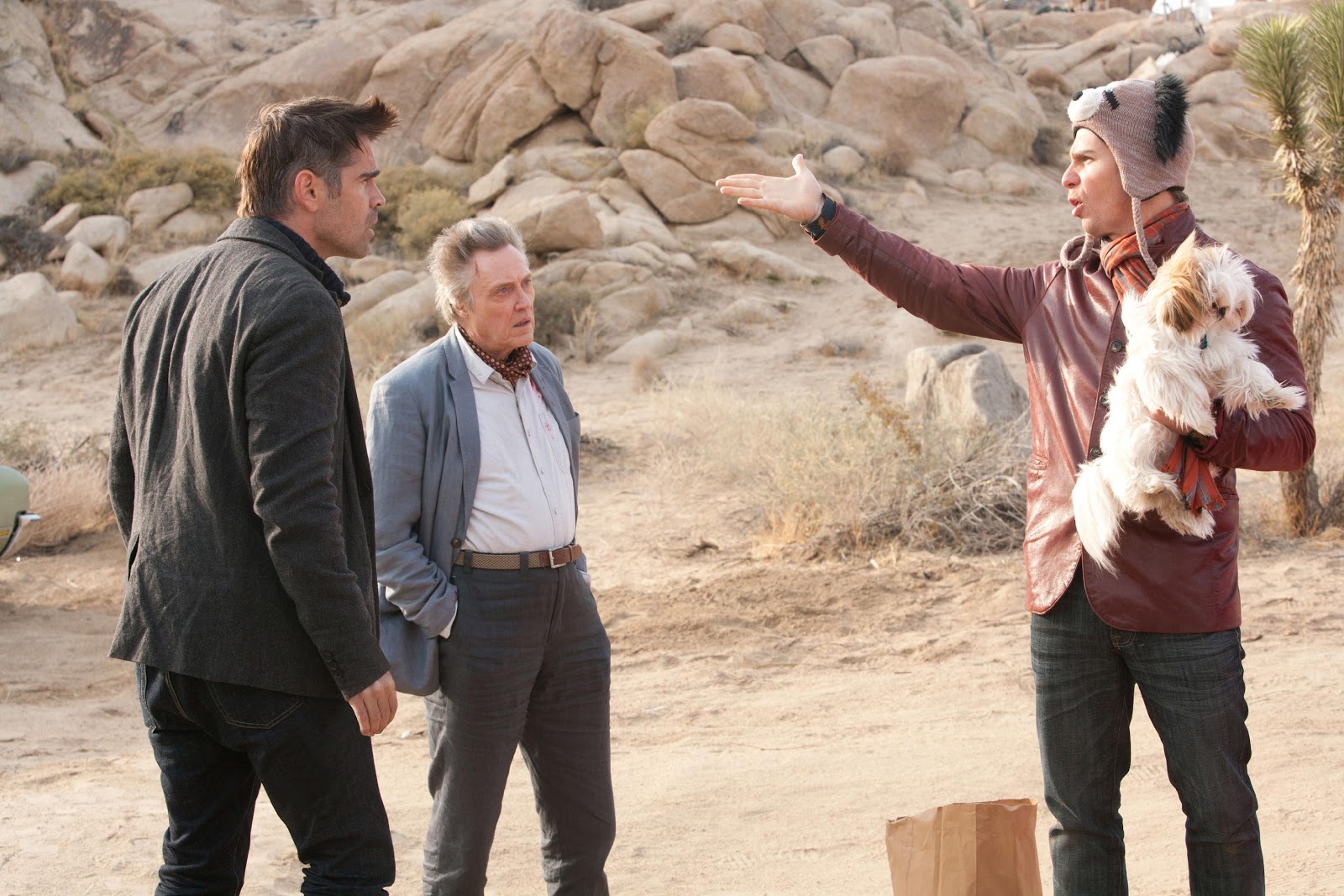
SEVEN PSYCHOPATHS - Meta Overload


SEVEN PSYCHOPATHS Review:

- I loved In Bruges. It was one of those movies that I snagged a free DVD of and watched on a whim one night, and then thought ... "wow, that ... kicked ... ass." Written and directed by playwright Martin McDonagh, In Bruges was a funny, stylish, gritty crime drama that felt like Tarantino, but with a serious infusion of Irish-Catholic pathos. In any case, I was very curious to see what McDonagh could do next, especially with the kind of all-star cast he'd lined up for Seven Psychopaths. Featuring a veritable cult-cinema  dream team, this is one of those films where you could seriously just watch the leads exchange oddball dialogue for two hours and go home happy. And luckily, the playwright McDonagh infuses his film with enough quirky and witty banter to give the likes of Colin Farrell, Christopher Walken, Sam Rockwell, Woody Harrelson, and Tom Waits all manner of great lines. Where the film falters though is in its narrative. Instead of a straightforward plotline, McDonagh attempts a meta-narrative - a movie-within-the-movie sort of thing, that is either over or under-ambitious, depending on how you look at it. Mostly, it feels like he's struggling to find a framework in which to place all of these quirky actors. And so Seven Psychopath ends up being a bit of a mixed bag. It contains numerous awesome scenes, and some fantastic performances. But it doesn't really ever come together with the punch that it needs to match the greatness of In Bruges.

Seven Psychopaths stars Colin Farrell as Marty, a Hollywood screenwriter struggling to write his next script, which he's on deadline to complete. Marty is sort of a sketchy dude - a borderline-alcoholic who hangs with shady folks like Billy (Sam Rockwell), a wannabe writer, part-time scam-artist, and possible psychopath. Billy works with another associate, Hans (Christopher Walken), on an ongoing enterprise that involves "borrowing" the dogs of rich people, and then "finding" them and returning them so as to cash in on the reward money. The problem is that Billy and Hans have just unwittingly stolen the dog of a crazy-ass criminal named Charlie, who figures out the scheme and puts a hit out on Billy and Hans. Marty gets caught up in their situation, even as he unintentionally sets himself up to get a whole truckload of inspiration for his in-stasis script. You see, Marty's script is called "Seven Psychopaths," and it's about seven psychos who get caught up in a caper. As the film progresses, we find that some of Marty's seemingly imaginary characters are actually, unknowingly, drawn from his real-life associates. We learn that some of Marty's friends are themselves psycho-killers. And ultimately, as the line between Marty's life and his screenplay become increasingly blurred, Marty realizes that he can't count on real-life events to play out in screenplay-friendly sequence or structure.

So there are essentially three "layers" to the film: 1.) the events actually happening to Marty and his cohorts, 2.) a parallel story dreamed up for Marty's "Seven Psycopaths" screenplay (often with elements drawn from actual events, or with elements that somehow manifest in reality), and 3.) the "meta" layer of all of this being a reflection of McDonagh's process in writing *his* Seven Psychopaths movie, and *his* struggle to come up with its characters and plotline. There is a really cool idea at work here - something that's been done to great effect in movies like Adaptation. But the implementation feels messy and random. McDonagh has a lot of fun playing with the idea of where truth and fiction intersect. But a lot of it boils down to "oh yeah, this guy ... is actually *this* guy!" sorts of reveals, that don't necessarily even make narrative sense. Christopher Walken's character, for example ... it feels like something is missing there. Same with Sam Rockwell - it feels like we're only seeing about half of the picture with him. What happens is that McDonagh sacrifices some narrative cohesiveness in the interest of giving us any number of individual scenes that are *really frackin' badass.*

That's the thing: Seven Psychopaths has dozens of moments that are flat-out awesome, but that make little sense in the bigger picture. But awesome they be. For one, one of the best conceits of the film is Marty's little asides where we are told the "origin" stories of his various psychopaths, as he imagines them in his screenplay. These are by and large fantastic. I loved the story of the badass Quaker who is followed into hell by his nemesis. The story of the once-tranquil Vietnamese priest, who travels to America after the war hellbent on bloody revenge - badass as all hell. And then there's the story of Tom Waits' character, Zachariah - a psycho who went on a killing spree with his wife, taking out America's worst serial killers with a dose of their own medicine. Waits sells it, and it's a great little side-story for the movie.

On that note, the movie often hits a sweet spot of delightful madness when it's just letting all these slightly-insane actors go at it. Colin Farell, I think, would be regarded as one of the greats if he only appeared in McDonagh movies. He's a natural with the hard-bitten dark humor of McDonagh's scripts. Let me put it this way: a phrase like "seven psychopaths" could be said in a lot of different ways ... but in Farell's hands, the phrase itself becomes a darkly hilarious running joke. Farell is great in this movie, and I'd be happy if he only ever again appeared in darkly funny, dialogue-driven crime capers for the rest of his career. Speaking of which, Sam Rockwell is also on his game here. As preposterous as his character is, you believe in him only because Rockwell is so good at playing off-kilter and unpredictable. And Christopher Walken is endlessly entertaining in this movie. His line readings are characteristically bizarre, but in a movie like this, that weirdness fits like a glove. But Walken also brings some genuine emotion to Hans - Hans' relationship with his wife, for example (beautifully played by Linda Bright Clay in a scene-stealing role), is handled quite well, and brings some real weightiness to the film. Woody Harrelson could probably play the role of loose-cannon gangster Charlie in his sleep, but there's also no one better you'd want for the role. And the movie is just littered with great actors, even in small roles. In addition to Tom Waits, there's appearances by Kevin Corrigan, Michael Pitt and Michael Stuhlbarg (in a little Boardwalk Empire reunion), Harry Dean Stanton, Gabourey Sidibe, and Zeljko Ivanek (seemingly in everything these days).

Still, one odd thing about the film is that its main female characters - with the exception of Bright Clay's - are so undercooked ... despite being played by able actresses like Abbie Cornish and Olga Kurylenko. Both characters are just sort of window dressing, despite seeming as if their roles in the film should be larger. Things get stranger, as McDonagh actually meta-comments on this, with it being mentioned that the female characters in Marty's script are paper-thin and relegated to background players. It's an attempt at cleverness, but it just seems like a roundabout way of apologizing for not letting Cornish or Kurylenko kick more ass. There are other parts of the film that seem lazy in this same manner. For example, a good deal of the script's characters are just casually racist and/or bigoted for no apparent reason. I'm not saying the movie itself is bigoted, but I just didn't see much of a point to some of the dialogue. Like, okay, Harrelson's Charlie is supposed to be dangerous and easy-to-hate ... but beyond that, some of the language used just felt awkward.

It's too bad, because most of the dialogue sings. I love great, stylized movie dialogue, and McDonagh is perhaps just a step below that rare class with guys like Tarantino and the Coens in this regard ... Like I said, mostly, it's a pleasure just to listen to the movie's great, often hilarious banter.

All in all, I'm left with some mixed feelings about Seven Psychopaths. There are some fantastic moments in it, and a knockout cast that is perfectly matched to the material. But I also couldn't help but feel that there wasn't enough here to justify the central, movie-within-a-movie conceit. In fact, it's a conceit that ultimately just serves to muddy the potentially strong characters and plotline. Think about In Bruges - part of why it worked so well was the focus on a main character who went through a very simple story of damnation/redemption, with lots of crazy and quirky stuff going on around him. Seven Psychopaths feels like idea overkill. It feels like because the central storyline wasn't strong enough, a whole other movie - about the making of this movie - was layered on top of it as a sort of band-aid. What we're left with is a movie chock full of badass moments and awesome-but-disconnected scenes, but one that never 100% clicks as a cohesive whole. On the other hand, you've got to admire a film with such lofty ambitions, that so freely dares to be weird and different and dark. I eagerly look forward to more movies from McDonagh, even if this one feels like a slight step back from In Bruges.

My Grade: B

Labels: , , , , ,